


THE BRIEF HISTORY OF THE NAGYENYED CASTLE CHURCH
Facts about the castle church:
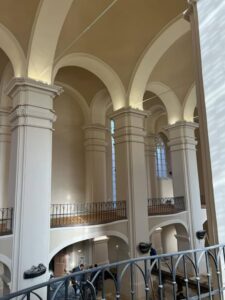
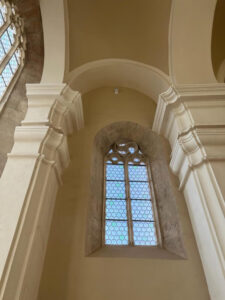
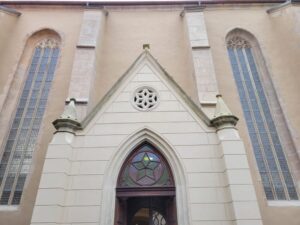 constructed between 1222-1239 by the decree of King IV. Béla of Hungary. Learning about the advancing danger posed by the Mongol armies to Europe, he ordered the construction of castles across the country. If we examine the church today, we can observe multiple architectural styles in its structure. It consists of a Romanesque-style tower, a simplified late Gothic exterior church with the original sanctuary, and a simplified late Baroque (three-nave) interior church. The explanation lies in the fact that the city and its church were destroyed five times and were always rebuilt in the architectural style of the era. As previously mentioned, the tower was built between 1222-1239. The addition of the church nave to the tower was completed in 1480. It is a single-nave late Gothic hall church with pointed stone ribbed vault.
Destructive sieges:
The second destruction took place in 1599-1600 when Prince Michael of Wallachia attacked from Hátszeg and burned Transylvania within a year, destroying most of its valuables. The city of Enyed and its castle church fell victim to this devastation.
 The third devastation occurred in 1658. The backstory: Prince George II Rákóczi, recklessly embarked on a campaign to acquire the Polish crown without seeking the advice of the Ottoman Empire (the Turks). His armies were defeated along the way, and he narrowly escaped due to providence. The prince’s recklessness was punished by the Ottoman Empire, Tartars, Turks, and other peoples who, under the banner of free plundering, devastated all of Transylvania, causing immeasurable damage. During this time, the Gyulafehérvár Collegium Academicum, founded by Bethlen Gábor in 1622, the valuable library, and the pharmacy of Transylvania (all in Gyulafehérvár) were destroyed. The attackers, led by the Tatar Khan, also reached Enyed. A sudden downpour partially reduced the scale of the arson and destruction.
The fourth destruction occurred on Palm Sunday, 1704 (March 16), when Colonel Tige, under the command of Austrian General Rabutin, attacked the city with his marauding troops. Despite a delegation led by Professor Pápai Páriz Ferenc from the college pleading for mercy, they were unsuccessful. Approximately 200 people perished in the clash, including 18 college students (the student grave is in the park). It was during this event that the pointed stone ribbed vault of the church nave collapsed under the weight of falling fiery beams. In 1720, a beam and plank ceiling were installed (a painted coffered ceiling is assumed). Then, between 1795 and 1804, the late Baroque, three-nave interior church with galleries was constructed. Jókai Mór immortalized the tragedy of that time in his novella ‘The Two Willows of Nagyenyed’ (in a romanticized adaptation).
The fifth and most significant devastation occurred on the night of January 8th to 9th, 1849 when the agitated Romanian population, stirred by the western mountainous region, attacked the city left defenseless. Men fought for common rights under the banner of the revolution, and in one night, nearly 800 people (women, elderly, and children) were slaughtered in -21-degree cold. The church was devastated, its archives destroyed, and its relics and valuables plundered. There is no battlefield or place in Greater Hungary where nearly 800 people perished in a day. Enyed led the way in this horrendous tragedy.
The Ecclesiastical Chronology of the Castle Church
In 1551, the first priest of Enyed signed the Lutheran Confession (in the same year, during the opening of the National Assembly held here, Martinuzzi Fráter György was forced to celebrate mass in Alsóorbo due to the absence of an altar).
On the night of July 19-20, 1551, Queen Isabella spent the night in the castle here with the Hungarian crown and handed it over to Castaldo in Torda on the 20th, passing it to the Habsburg family, who owned it for centuries. (This is the last time the crown was in Hungarian possession).
Between April 11-13, 1564, under the presidency of Blandrata György’s princely envoy, a separation occurred, distinguishing the Lutheran and Calvinist churches. The latter, the Transylvanian Reformed Church District, was established by the Nagyenyed Synod in 1564. It was here and at this time that the first bishop of Hungarian Reformed Christians in Transylvania, Ferenc Dávid, was elected. Thus, Enyed can be considered the cradle of the Transylvanian Calvinist church.
On June 2, 1577, at a synod convened by Kristóf Báthory, András Tordai Szabó was elected as the second bishop of Hungarian Reformed Christians in Transylvania.
In 1599, the General Synod decreed that two synods be held annually, with the winter synod’s location always being Nagyenyed.
In 1646, the synod ordered the establishment of presbyteries.
In 1682, the Supreme Consistorium, a committee comprising secular and ecclesiastical members (from which the present-day Board of Directors developed), was established in the Enyed church.
In June 1698, Misztótfalusi Kis Miklós was humiliated at the Enyed Synod and was sentenced to ecclesiastical excommunication for the grammatical corrections made in the Golden Bible printed at his own expense (more detailed information about him is found in the chapter dedicated to him).
Between 1782 and 1849, it served as the headquarters of the Transylvanian Reformed Church Diocese (Episcopal).
In 1795, the moat surrounding the castle was filled (outside, the castle was surrounded by a moat filled with water from the stream).
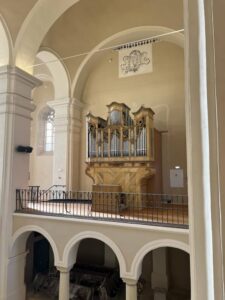
The organ was built in 1811, central heating was installed in 1912, and electric lighting was installed in the church in 1924.
Bishops
 Bishops buried in the cemetery of Nagyenyed:
- Kolozsvári István ( ? – 1717)
- Marosvásárhelyi Karancsi István ( ? – 1728)
- Szigeti Gyula István ( 1678 – 1740)
- Dézsi Lázár György ( ? – 1773)
- Eperjesi Zsigmond ( ? – 1793)
- Keresztes Máté ( ? – 1795)
- Abats János (1745 – 1815)
- Bodola János (1754 – 1836)
 Nagyenyed pastors who also served as bishops (their tenure in the bishopric is given in parentheses):
- Tasnádi Veress (Ruben) István (1605 – 1616)
- Csulai György 81627 – 1635)
- Borosnyai Lukács (1728 – 1740)
- Csernátoni Vajda Péter (1782 – 1784)
- Antal János (1836 – 1848)
- Dr. Bartók György (1899 – 1907)
- Nagy Károly (1918 – 1926)
- Dr. Makkai Sándor (1926 – 1936)
Since the Reformation, 59 pastors and 65 assistant pastors have served in the congregation.
In a nutshell, outlining the important role played by the Reformed Church in Nagyenyed in recent centuries, as a stronghold of Hungarian culture and education (here, church and school are inseparable), the venue for synods and national assemblies, one of the cradles of the Transylvanian Reformation, theological education until 1895, the Episcopal seat for a long time, and the building severely affected by many battles and devastations. Its structural integrity weakened, to the extent that during a service, a significant portion of plaster fell into the church from a height of 16 meters. The church required substantial restoration. The comprehensive restoration plan was completed, and on September 3, 2018, the most extensive renovation of the church in history began.
Blessed with the power of God and tirelessly put to earthly work, after more than five years of hard labor, the castle church shines as never before in its glory. Unlike Western Gothic architecture, which remained free from blood and soot over centuries, much more was borne by the Nagyenyed church, as our ancestors fought the battles and endured the oppressors’ malice to keep the western part of Europe safe. With God’s help, we overcame the centuries-old gate, hoping for centuries to come: ‘Because I live, ye shall live also.’ (John 14:19b).
TRANSYLVANIA GAVE, ENYED INITIATED, AMSTERDAM MADE WORLD-FAMOUS
Misztótfalusi Kis Miklós (1650 – 1702) studied in Enyed for 11 years (1666 – 1677), and after mastering all knowledge from his professors here, he prepared for Western peregrination (university studies). His renowned teacher, Ferenc Pápai Páriz, advised him not to improve his theological knowledge but to learn the art of printing, ‘because Transylvania needs books.’ In October 1680, he arrived in Amsterdam, where he learned the craft of printing and typecasting at the Blaeu printing house. He became an outstanding type cutter, and from 1686, orders arrived from all over Europe (even from the Roman Pope), including Hebrew, Greek, and Armenian letters. He created the first printed Georgian and Coptic alphabets. Between 1686 and 1689, his type specimen was significant on an international scale. It was clarified in 1954 that the typeface cherished throughout Europe for centuries, previously attributed to Anton Jansson, was Misztótfalusi’s creation. He dedicated his significant wealth to the expenses of publishing the Hungarian Bible. In 1689, he closed his thriving workshop in Amsterdam with the intention of establishing a print shop and returned to Transylvania. He had 84 own publications. The most important among these was the GOLDEN BIBLE published in Amsterdam in 1685, named for the golden layer covering the edges of the publication. He performed grammatical and spelling corrections in the Bible, sharply criticized by the conservative church authorities here. Simultaneously, he laid the foundations of modern Hungarian grammar and spelling. His hope turned to sorrow; departing from the Enyed church to serve his people in Holland, he was humiliated at a synod held in the Enyed church on June 11, 1798. His Defense was destroyed, and he was sentenced to ecclesiastical excommunication. Shortly after his shameful humiliation, he suffered a stroke, remaining paralyzed for three years but with a sound mind until his death on March 2, 1702.
 Golden Bible (published in 1685 in Amsterdam, 3500 copies), New Testament and Psalms (published in 1686 in Amsterdam, 4200 copies). His endeavor was to provide as many Bibles as possible to the people at the cheapest cost to spread literacy. Upon returning home, he aimed to meet the textbook needs of schools, published handbooks for state and public affairs, and released the works of Ferenc Pápai Páriz and György Felvinci, Comenius’ textbook, Balassi and Rimay Istenes’ songs, Nyéki Vörös Mátyás’s poems, and Haller János’s Triple History. He self-financed and distributed for free Szőnyi Nagy István’s Hungarian School ABC book (1695).
Today, a memorial plaque on the left inner wall of the church entrance commemorates Misztótfalusi Kis Miklós.
Nagyenyed, in the month of November 2023.
Tóth Tibor-László
Reformed Pastor